Ready to dance? Browse the options below to get started









Design Inspiration
The Rise of the Milonga
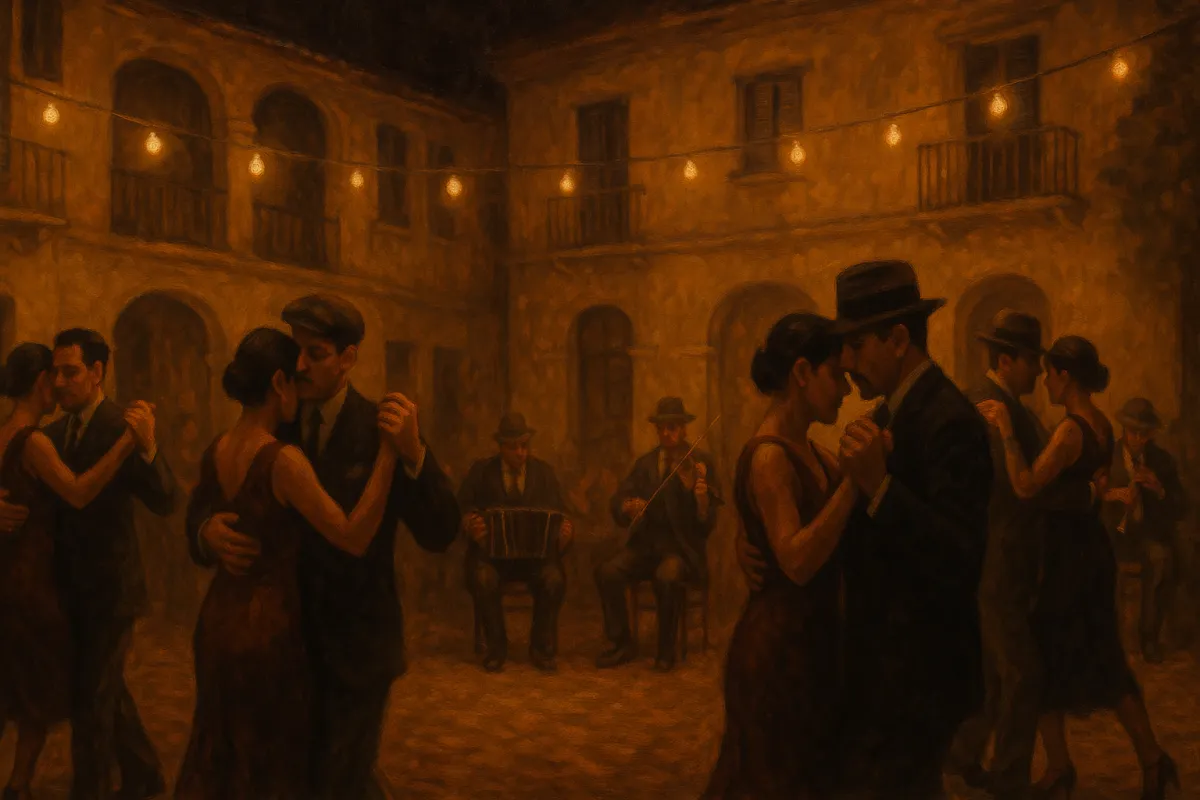
[Photo Credit: Sora]
While today’s milongas often feel polished and ceremonial, their origins are anything but. Let’s take a closer look.
🌆 Where did the first milongas happen?
The word "milonga" originally referred to a musical style, not a social event. But by the late 1800s, as tango began to emerge in the working-class neighborhoods of Buenos Aires, the term started to describe informal dance gatherings too. These early milongas weren’t held in grand salons. They took place in conventillos (tenement courtyards), makeshift bars, and modest neighborhood clubs.
There were no formal dress codes. No playlists. Just live musicians, dancers of varying skill levels, and a desire to connect. In many cases, the spaces were too tight to perform complex figures, which is partly why tango's early style emphasized walking, pausing, and musicality over showy movements.
Side note: The familiar structure of tandas and cortinas — with 3 or 4 songs of the same style followed by a short musical break — wasn’t standard in those early years. Musicians played live, often improvising the set order. A typical sequence like tango, tango, vals, tango, tango, milonga only became formalized later as tango culture matured!
As noted by tango historian Michael Lavocah, during the Golden Age, orchestras did not play in tandas for dancing. Initially, a tanda was often only two songs long—the two sides of a 78rpm record. The tanda format we recognize today became widespread in the early 1970s with the reissuing of old music on LPs, which made it easier to play three or four songs in a row.
Full Article (Tango DJing - Part 1: Music for dancing)
🌟 What made milongas move up the social ladder?
For a long time, tango and its associated gatherings were dismissed by Argentina’s upper classes as crude or immoral. But when tango made its way to Paris in the 1910s, it caught fire. Parisian fascination turned tango into a cultural export Argentina could suddenly be proud of.
The result? A rebranding of sorts. Tango gained legitimacy, and so did the milonga. Elite venues began hosting their own dance nights, borrowing from working-class tradition but adding formal etiquette and fashion. Men wore suits. Women wore gowns. The atmosphere became more curated, and so did the expectations for behavior.
This is also when many of the códigos — the informal "rules" of the milonga — began to emerge. These codes shaped how dancers interacted and created a social framework that made everyone feel safer and more respected on the floor:
Use of the cabeceo (inviting with eye contact and a nod) instead of walking up directly
Returning your partner to their seat at the end of a tanda
Avoiding cutting across the dance floor
Entering the ronda (line of dance) with awareness and permission
These weren’t just rules for rules’ sake — they reflected tango’s growing maturity and its adaptation to more formal, shared spaces. The milonga became not only a place to dance, but a place to perform one’s role in a deeply collaborative social experience.
🚀 How has the milonga evolved around the world?
Today, milongas are a global phenomenon, with vibrant communities dancing across every continent. While the heartbeat of tradition still echoes from Buenos Aires, each region brings its own twist to the milonga experience.
In Europe, especially in cities like Berlin, Paris, and Warsaw, you'll find a mix of tradition and innovation. Some milongas lean formal, others experimental, but most hold fast to the structure of tandas and codigos — with a few modern liberties (ever heard of naked tango?!).
In Asia, communities in Tokyo, Seoul, and Bangkok are known for their attentiveness and precision, often embracing codigos with quiet rigor and a touch of ceremonial grace.
In the Middle East, scenes in places like Istanbul and Tel Aviv navigate a fascinating balance between traditional gendered norms and growing inclusivity, often drawing from both conservative and queer-friendly tango spaces.
In the United States, the tone can shift from coast to coast — from casual, community-driven scenes with pizza and hugs in Portland, to polished, showy nights out in New York and L.A.
While the essence of the milonga — connection, musicality, and flow — remains constant, what’s changing is how communities interpret the códigos. Today, many spaces are actively rethinking and reshaping traditional codes to meet the needs of diverse dancers. Queer tango movements, non-gendered roles, and consent-based partner selection are becoming more common, especially in progressive communities.
The milonga has always reflected the world around it. That hasn’t changed. What has? We're now more conscious of who gets to feel welcome — and how tradition and evolution can dance together in the ronda.
Written by Amanda Garley, co-founder of Vienna Tango School, with research and drafting support from ChatGPT (because even tango historians deserve a little AI assist).
Want to feel the history in motion? Join us at our next milonga or class and see how much tradition lives in each tanda (VTS Events).

Design Your Dream Space Today!
Transform your space into a stylish, functional sanctuary with our expert design services
Transform Any Room into a Masterpiece!
Transform your space into a stylish, functional sanctuary with our expert design services
Elevate Your Home's Style
Transform your living space into a true reflection of your personality. Our interior design experts work with you to create beautiful, functional spaces that elevate your home’s aesthetic and improve everyday living. From concept to completion, we make your dream space a reality.
Bring Your Vision to Life
Frequently Asked Questions
Do you offer delivery, and how much does it cost?
Yes, we offer delivery across the country, ensuring your furniture arrives safely and on time. Delivery fees vary depending on your location, the size of your order, and any additional services you choose, such as in-room placement or assembly. You can view exact delivery costs during checkout before completing your order.
Can I track my order?
Absolutely! Once your order has been processed and shipped, you will receive an email with a tracking number and a link to monitor your shipment in real time. You can also log in to your account on our website to check the status of your order at any time, ensuring you know exactly when to expect your delivery.
What is your return policy?
We want you to love your purchase. If you’re not completely satisfied, we accept returns within 30 days of delivery on eligible items. Returned items must be unused, in their original packaging, and in resalable condition. Please note that return shipping fees may apply, and some items, such as clearance or custom pieces, may be final sale. Visit our Returns page for step-by-step instructions on how to start a return.
Do you offer assembly services?
Yes, we offer professional assembly services in select areas to make setting up your new furniture easy and hassle-free. This service can be added during checkout if it is available in your delivery area. Our team will assemble your furniture in the room of your choice and remove any packaging materials, allowing you to enjoy your new pieces immediately.
For your convenience, we accept all major credit cards (Visa, MasterCard, American Express, Discover) and PayPal for secure online payments. We also offer financing options at checkout, allowing you to furnish your home now and pay over time with easy monthly payments. All transactions on our website are encrypted and secure to protect your personal information.
We accept major credit cards, PayPal, and financing options at checkout to make your purchase easy and secure.

Discover the In-Store Experience
Step into our showroom and explore curated collections you can see, feel, and test for comfort and quality. Take your time browsing while our friendly team is ready to help you find pieces that match your style and needs, ensuring a stress-free, inspiring shopping experience.

Free 1-on-1 Design Consultation
Get personalized help furnishing your space with a free 1-on-1 design consultation. Our experts will guide you in selecting the right pieces, layout, and colors to match your style and budget. Whether you’re redoing a room or a full home, we’ll help bring your vision to life.
CONTACT US
Call Center:
(571) 603-7844
Hours:
Mon-Sat: 8am - 10pm CT
Sun: 11am - 6pm CT
Text Us:
Message 48273
Keyword HARVEST
Data Rates May Apply
Find a Showroom
ACCOUNT
FINANCING
OUR COMPANY
HELP CENTER
SUBSCRIBE TO OUR NEWSLETTER
FOLLOW US ON SOCIAL MEDIA



© Copyright 2026. Vienna Tango School. All Rights Reserved.