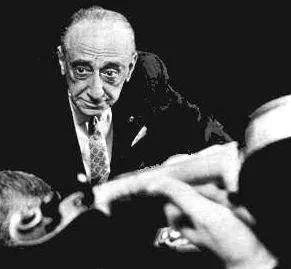
2/4, 4/8, and the Engine of D’Arienzo’s Tango
Why Juan D’Arienzo Feels Like a March: 2/4, Subdivision, and the Rhythmic Engine of Tango
Juan D’Arienzo’s choice to work in 2/4 — or more precisely, in a two-beat bar with a very strong internal subdivision — is central to why his music feels so driving, energetic, and almost march-like to dancers.
That feeling is not accidental. It is one of the reasons D’Arienzo became known as “El Rey del Compás” — the King of Rhythm.
When dancers talk about D’Arienzo, they often describe his music as irresistible, propulsive, and impossible not to walk to. Even before you know anything about notation or time signatures, your body can feel it: the music seems to push forward with remarkable clarity. It tells you where the beat is. It invites you to trust it. And it makes you want to move.
A performance like the one below, Loukas Balokas & Georgia Priskou dancing to “No mientas,” captures exactly that quality: the orchestra generates such a clear rhythmic spine that the dancers can play freely on top of it without ever losing the groove.
Loukas Balokas & Georgia Priskou dance Juan D'Arienzo - No mientas at Sheffield Primavera Tango Festival.
A quick primer on time signatures
When we talk about “2/4,” “4/4,” or “4/8,” we’re talking about a time signature. This is a simple way of showing how music is organized into repeating units of time called bars (or measures).
The top number tells you how many beats are in each bar.
2/4 = 2 beats per bar
4/4 = 4 beats per bar
4/8 = 4 beats per bar (but counted in smaller notes)
The bottom number tells you what kind of note gets one beat.
“4” means the quarter note is one beat.
“8” means the eighth note is one beat.
In dance terms, you can think of a bar as a small “box” of time that repeats over and over. In 2/4, you feel that box as “ONE‑two, ONE‑two,” like a march. In 4/4, the same span might feel like “ONE‑two‑three‑four,” which is more common in pop, rock, and a lot of later tango notation.
What makes D’Arienzo interesting is not just which numbers appear on the page, but how clearly he makes you feel those beats in your body. His music often feels like two big steps per bar, with the energy of four smaller pulses inside it—exactly why dancers can play with different ways of stepping (on 1‑2‑3‑4, on 1 and 3, or on every “and” in between) without ever losing the groove.
2/4 in early tango and why it mattered
Before the 1920s, tango belonged to what is often called the guardia vieja period. This earlier tango was typically faster, lighter, and more directly dance-oriented. It was often written in 2/4, with a clear, compact pulse that made it highly functional for dancers.
As tango orchestras evolved, however, the style also changed. Many composers and arrangers moved toward slower, more lyrical writing, often in 4/4, with longer phrases, more rubato, and more melodic expansion. This music could be beautiful, elegant, and emotionally rich — but it was sometimes less sharply rhythmic for social dancers.
D’Arienzo’s great intervention was to insist that tango needed its rhythmic spine back.
He believed tango should return to a clear, percussive beat — something dancers could hear immediately and respond to physically. He spoke openly about the “purity of 2/4,” and for him this was not merely a matter of notation. It was a broader artistic philosophy: tango had to be vivid, direct, and danceable again.
In other words, D’Arienzo’s rhythmic choices were not just compositional. They were social. They were aimed at the dance floor.
And they worked.
2/4, 4/8, and the “march” feeling
Although D’Arienzo’s arrangements are usually written as 2/4, many analysts point out that what dancers actually hear can feel closer to 4/8.
Why?
Because each of the two main beats is so strongly subdivided that the internal pulse becomes extremely active. Instead of simply hearing:
ONE-two
you often feel something more like:
ONE and TWO and THREE and FOUR and
This creates the sensation of two large beats containing four lively internal pulses.
That is a major part of why D’Arienzo can feel almost like a march.
Marches are often written in 2/4, with a firm, steady, highly legible pulse. D’Arienzo creates a similar effect in tango by building a rhythmic foundation that is:
stable
forward-moving
strongly articulated
minimally delayed
He minimizes long drags and luxuriant suspensions. Instead, he favors attack, clarity, and continuity.
The result is a band sound that can feel almost percussive. Bass, piano, and bandoneones often articulate the beat so clearly that dancers experience the music as:
walk, walk, walk, walk
or
left-right-left-right
That strong articulation is also why some listeners occasionally confuse brisk D’Arienzo tangos with milongas: the tempo is lively, and the subdivision is so vivid that the music feels compact and intensely rhythmic.
Energy, young dancers, and “rhythm over melody”
By the 1930s, when tango attendance had started to waver, D’Arienzo’s style stood out dramatically from the more romantic, legato orchestras around him.
He deliberately favored rhythm over long melodic lines.
That does not mean melody disappeared. It means melody was no longer the only thing asking for attention. The orchestra’s rhythmic engine became the star.
Compared with more suspended, lyrical styles, D’Arienzo’s music often features:
fewer dragged notes
fewer long, hovering phrases
more short attacks
more clearly defined accents
greater rhythmic insistence
For dancers, this had enormous advantages.
1. The beat was easy to hear and trust
In a crowded milonga, clarity matters. D’Arienzo’s pulse gave dancers confidence. You knew where the floor was. You knew where the next step could land.
2. The subdivisions invited play
Because the inner pulse was so alive, dancers suddenly had options. They could:
walk simply on the main beats
dance half-time on 1 and 3
add quick double-time steps
syncopate
play with rhythmic density without feeling lost
This is one reason D’Arienzo’s recordings became such a powerful engine of the Golden Age dance revival. His music was not only exciting; it was usable.
Why D’Arienzo feels so good to dance
From a dancer’s perspective, D’Arienzo is generous.
He gives you structure and freedom at the same time.
The structure comes from the beat. It is clear, stable, and almost impossible to miss. The freedom comes from the subdivisions inside that beat. Because the rhythm is so well defined, you can simplify or complicate your stepping without losing coherence.
That means a beginner can walk to D’Arienzo successfully.
It also means an advanced dancer can layer in:
syncopations
double-times
traspie-like play
half-time stretches
rhythmic contrast
All over the same underlying groove.
This is one of the reasons D’Arienzo remains such a favorite for teaching musicality. The rhythmic levels are audible enough that dancers can explore them consciously.
“El Flete” as a timing laboratory
“El Flete” as a timing laboratory
One of the best pieces for studying this relationship between notation and feel is “El Flete.”
Historically, “El Flete” belongs to that earlier lineage of upbeat tango pieces conceived in a two-beat frame, and early commentary treats it as a 2/4 tango.
At the same time, modern musicians and transcribers sometimes notate it differently:
some present it in 4/4, which makes phrasing easier to read on the page
others argue that what D’Arienzo is actually doing feels closer to 4/8, because the rhythm section so strongly articulates four eighth-note pulses grouped into two beats
For dancers, this is not just a theoretical issue. It affects how the music can be used in the body.
In “El Flete,” you can hear and dance multiple levels at once:
every pulse: “ONE two THREE four”
half-time: “ONE … THREE …”
subdivision: “ONE and TWO and THREE and FOUR and”
That makes it an ideal teaching tool. It shows how different step densities can coexist over the same groove.
A dancer can choose simplicity, or density, or contrast — and all of it still feels grounded in the music.
That is part of what makes Clarisa Aragón and Jonathan Saavedra dancing to “El Flete” (below) so compelling: the orchestra offers a rhythmic grid that is both stable and alive, allowing the dancers to make sophisticated timing choices without sacrificing clarity.
Clarisa Aragon and Jonathan Saavedra dance “El flete“ by Juan D'Arienzo at Tangotanzen macht schön in Berlin, Germany.
“No mientas” and D’Arienzo’s rhythmic design
“No mientas” and D’Arienzo’s rhythmic design
“No mientas” offers another especially transparent example of D’Arienzo’s rhythmic design.
In this recording, much of the bass writing and accompaniment is built on straightforward, repetitive figures that lock firmly into the two-beat frame. Above that, the upper voices are free to add color, texture, and insistence.
In “No mientas” you can hear:
a bass line that marks out the fundamental pulse with almost relentless regularity
upper voices — violins, bandoneones, piano — articulating off-beat attacks and repeated staccato figures
a rhythmic texture that feels almost “hammered” into place from multiple directions
For dancers, that makes the track a superb timing exercise.
You can:
dance simply on the beat and feel the march-like engine
fill in the “ands” for syncopation and double-time
switch between stepping on every beat and stepping only on 1 and 3
explore contrast without losing phrasing
Because the melody and harmony remain relatively clear while the rhythm section stays so legible, the piece teaches musicality without becoming confusing.
It lets dancers hear the difference between:
stepping only on the main pulses
filling in subdivisions
stretching across beats
All while staying inside the same unmistakable groove.
A practical listening exercise for dancers
The next time you put on D’Arienzo — especially “El Flete” or “No mientas” — try this:
First listen
Do not dance. Just clap or tap the main pulse.
Ask yourself:
Do I feel two large beats or four smaller ones?
Where does the rhythm feel the strongest?
Second listen
Walk on every pulse you hear.
Try:
ONE TWO THREE FOUR
Notice how energized and direct that feels.
Third listen
Now walk only on:
ONE … THREE …
Feel how the same music suddenly becomes more spacious, even though the groove does not disappear.
Fourth listen
Experiment with:
ONE and TWO and THREE and FOUR and
Add syncopations or double-time where the music invites it.
This is the genius of D’Arienzo: he makes all of these layers available without ever letting the floor fall away beneath you.
Why this matters for tango dancers today
Understanding D’Arienzo’s rhythmic design can help dancers make better choices.
Instead of dancing every D’Arienzo track the same way, you can start to ask:
Am I hearing the large two-beat structure?
Am I responding to the active subdivisions?
Do I want to walk simply, or play?
Where can I create contrast?
Where does the rhythm ask for insistence, and where does it allow space?
The point is not to become a music theorist.
The point is to hear more clearly, and therefore dance more intentionally.
D’Arienzo’s orchestra gives dancers a rare gift: a pulse strong enough to trust, and a subdivision rich enough to explore.
Quick reference: timing concepts in words
Here is the short version:
Historical root: early tango was upbeat, dance-oriented, and often written in 2/4
D’Arienzo’s return: he revived that clear two-beat pulse to re-energize social dancing
Practical feel: many dancers experience his music as functionally close to 4/8 — two big beats, each subdivided into a very active “and”
Dancer’s count:
Simple: “ONE, TWO, THREE, FOUR”
Half-time: “ONE … THREE …”
Double-time: “ONE and TWO and THREE and FOUR and”
Tracks like “El Flete” and “No mientas” are especially useful because they make all three levels audible. They help dancers practice moving between densities without ever losing connection to the march-like drive underneath.
Final thought
D’Arienzo did not simply make tango faster.
He made it clearer.
He restored a pulse that dancers could feel instantly, trust completely, and play with endlessly. That is why his music still feels so alive on the social floor: it gives you both direction and possibility.
The time signature may live on the page.
But D’Arienzo made it live in the body.